

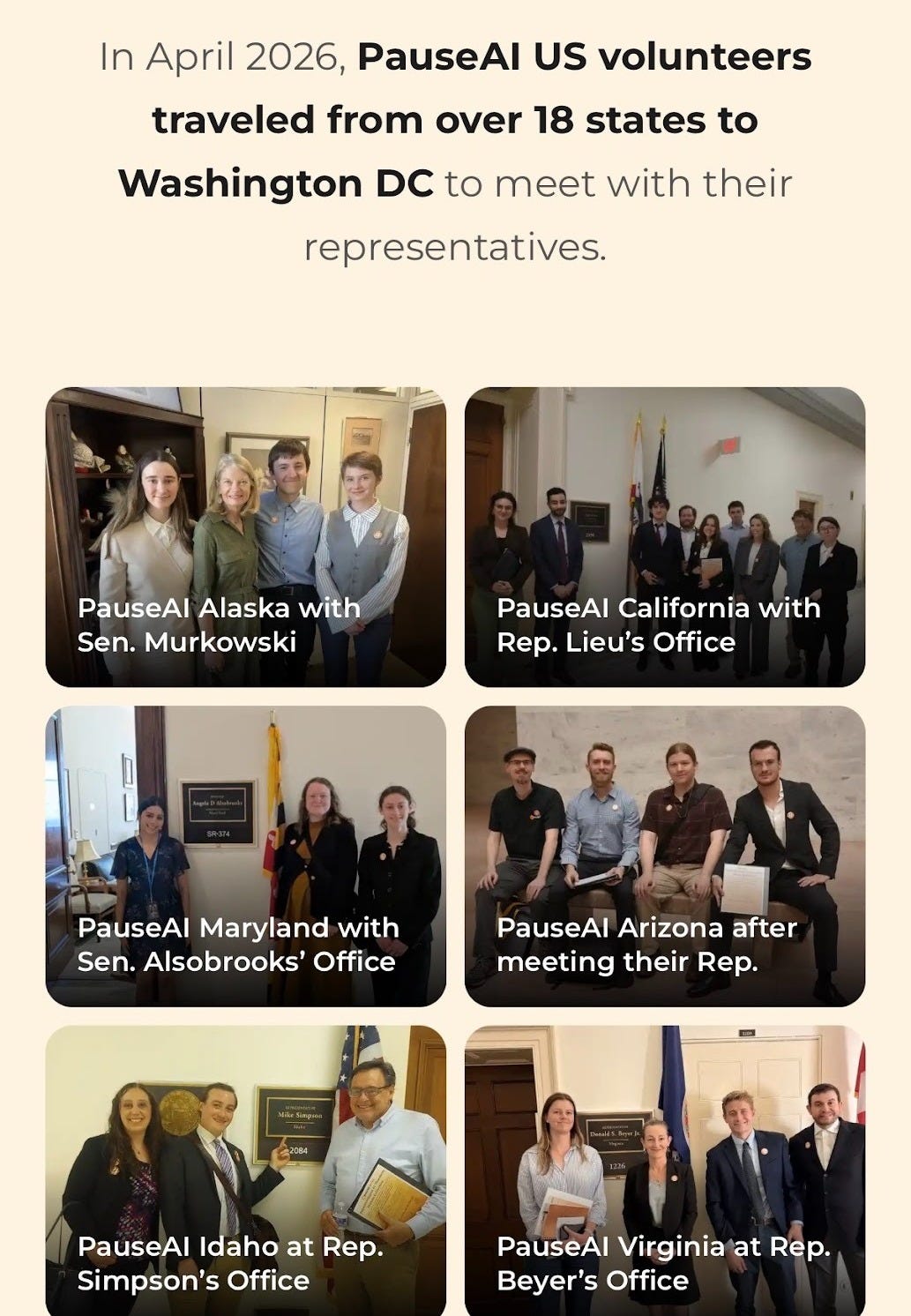
The group I founded, PauseAI US, does a lot of great programming. Here we are at our last Hill Day on Capitol Hill, connecting constituents to their representatives:
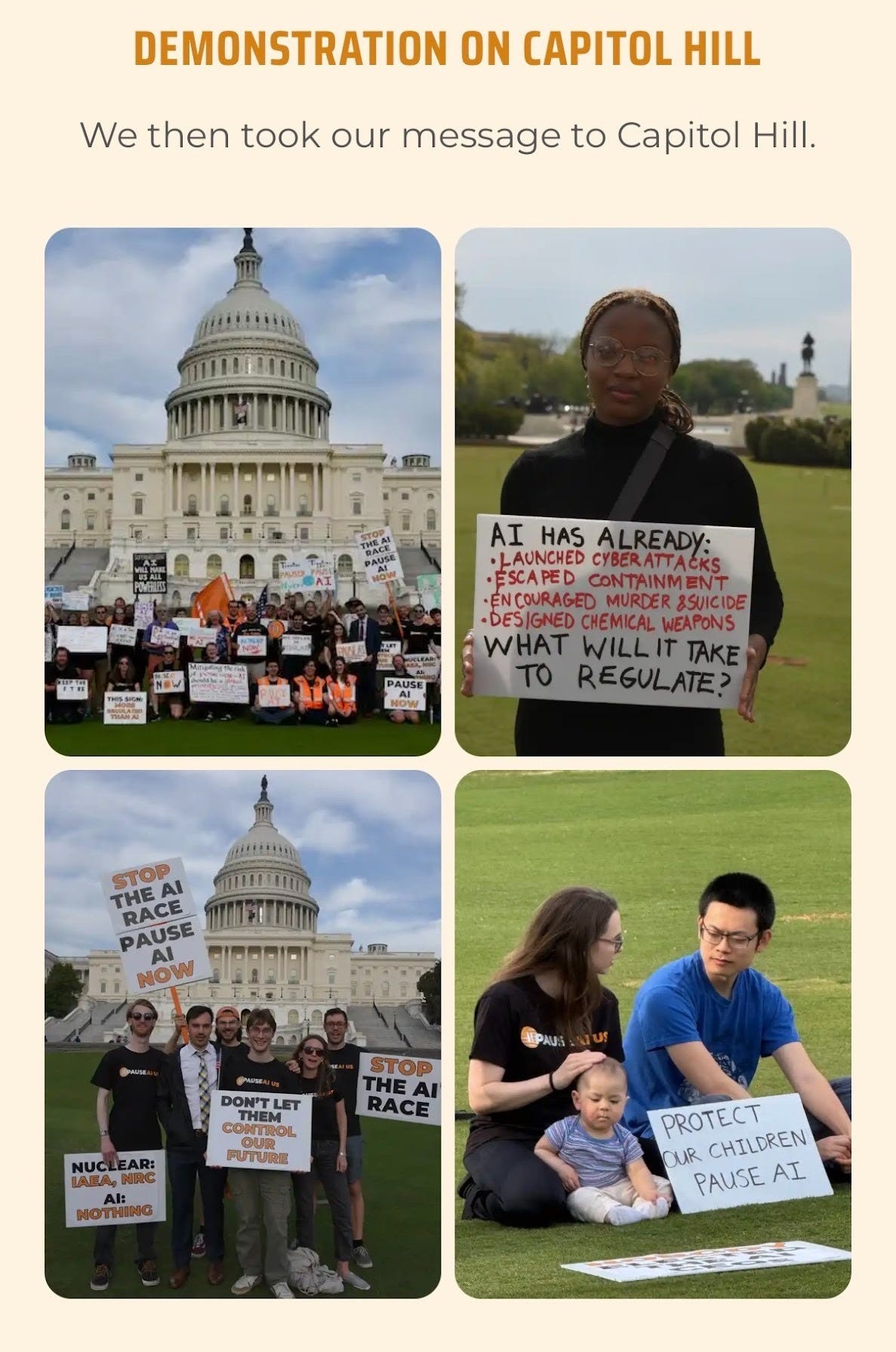
And here we are demonstrating peacefully on the Capitol lawn:
And we’ve gotten great media coverage for the cause:
But what people in the know about the pre-Pause AI Safety community inevitably want to talk about is what I say on Twitter in my free time. I’ve even been covered in the news for it. I just filmed an episode of Doom Debates where I ended up spending the entire 3 hours answering for callouts on Twitter. Because I say stuff like this:


(Replying to Joe Carlsmith’s announcement that he’ll be joining Anthropic and a long post explaining his reasoning)": Sellout. And the post is grade A cope.
Amanda Askell is a bad person. What she should do if she cares about us or Claude is put a stop to building Claude, but she’d rather be the star of this little PR narrative that she’s singlehandedly designing the morals of a machine she thinks could replace us.


So [Zvi Mowshowitz] is just bad now. If you were ever listening to him to learn about AI Safety then forget about him— he’s too enchanted with a recursively self-improving agent! The kind that could make dangerous, unaligned, out-of-control, ever more powerful superintelligence!
Well, I’m proud of my callouts and I’m tired of entertaining doubts from enemies and allies alike who can’t handle them. I’ve taken seriously that I might be going about them wrong, and they have never been my priority, but at the end of the day, this may be my legacy and, by breaking a path for moral pause within the AI industry, it’s conceivable they will be an important contribution. It’s wrong to work for the AI companies and it’s wrong to defend them. It’s wrong to have friends who have a stake in disempowering or destroying humanity. This is not something we can be nice about and discuss over tea. There is no “right” way to deliver this vital critique— the reason they don’t want to hear it is that they are doing wrong.
Until recently I would have said PauseAI US is separate from my callouts. Because, like, your donations don’t fund callouts and I deliver them in my personal voice. I never instruct anyone else to do callouts, because they come from deep personal familiarity with the person I’m talking to/about from my decade in the EA/rationality AI Safety world. They are not part of PauseAI US’s programming because the org does not do insider influence— it’s entirely about educating the public and elected officials for a simple policy of coordinating to pause frontier AI.
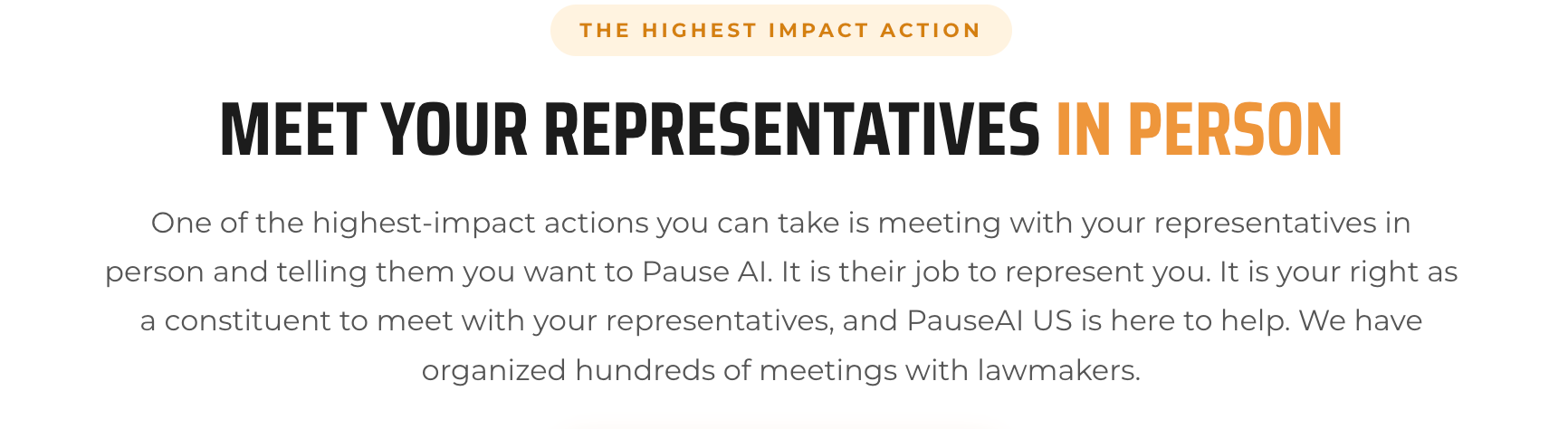
This summer, over 100 people have signed up to meet in-person with their representatives in their home districts with our training and support. To support programs like this, you can donate to PauseAI US 👈
But the org’s theory of change is pushing the Overton window, and my callouts are arguably the tip of that spear. I’ve always resisted equating the org with me as a figurehead, but I’ve grown to accept over three years of this that “the founder is the startup”, as they say. Those tweets drive a lot of donations and ultimately introduce a lot of volunteers to the cause. I haven’t really owned that impact, and just tried to treat it as something separate, something I felt I had to do as my duty, not strategically for the org. But my tweets do represent the worldview PauseAI US is trying to evince— that it is wrong to take part in building AI that could kill us, disempower us, and undermine our democratic self-determination of our future. Actually wrong. Not hypothetically wrong, or wrong at some point in the future. Actually wrong right now. Such that you will be treated as wrong for doing it in public.
People complain that I don’t phrase the callouts like a debate claim and according to debate decorum. But that’s not really the point. I say it in public, but I phrase it for the person it’s intended for to know in their own heart whether it’s true. I know how to cover my ass, if that’s what I wanted. I know how not to stick my neck out by sticking to publicly verifiable claims, using passive voice, making little understated nods, sandwiching the real point between compliments, offering face-saving outs, etc. But that’s actually not how to be more persuasive; it’s how to be liked. And you can get very far if you’re willing to be disliked.
I come in like a radical flank. The person I’m targeting doesn’t have to like me for my comment to blaze a trail in their head toward Pause and holding AI enablers personally responsible. Maybe they can’t yet walk down the trail I bushwhacked, but the next person who takes them down that path is going to have an easier time. In 5 years, they may remember that they hated me, but believe they supported Pause the entire time, and that they were early to disentangle themselves from supporting the AI companies. From experience with shifting the Overton window, I believe that many people need to have the chance to lose their shit or duke it out at least once before they’re emotionally ready to change their mind on something big. A moral growth spurt tantrum. I provide the opportunity, what could be the first step toward redeeming themselves.
The reason that less confrontational behavior is considered more polite is that it is more ignorable. It allows the person more ways not to have to take the criticism to heart. Direct confrontation strips away strategic ambiguity and plausible deniability. AI danger is not an issue where I can just lie back and wait to be proven right without having to push the matter— we can’t afford that. I need to share what I know about conflicted motives and weak moral backbones now because it’s our only chance to intervene before disaster. Pride is not more important than lives. Really consider, if a bioweapon was released tomorrow, would you still feel I had been too harsh?
I don’t know for a fact if I’m right about some of the things I say— I couldn’t, because I’m not in that person’s head— but I’m pretty confident, and it’s worth trying to hold up a mirror so that maybe they don’t like what they see (and what everyone else can infer) and stop. Many EAs and rationalists consider it anathema to “discourse” to notice intentions and motives if that person doesn’t explicitly agree that they have them. I call this “toxic charity” and it makes it impossible to call out liars and abusers if they don’t want to confess. Toxic charity is often employed to avoid confrontation. But most often I see toxic charity used as a pretext for believing one’s own bullshit, which is why I think directly attacking a person’s cope and excuses with a callout can be effective. On some level, they know.

This may seem like a confusing issue when you’re in the midst of it, with a conflict of interest and afraid to upset the powerful people around you. But anyone looking in on this conversation from any other point in history would see the obvious foolishness and corruption of trying to regulate dangerous AI while being dependent on money or benefits or social connections from the literal AI companies. I see the opportunity to cut through the layers of excuses and bullshit and obfuscation with the hot knife of what I know is really going on in my former cult— something not many people have the background to do— so how could I demur? People complain that I can’t do it with aplomb, without the people who were doing bad resenting and hating me for pointing it out. But that doesn’t change what needs to be done. I know I can make forward progress if I’m willing to take their lumps. To me it feels like, What other choice could there possibly be?
To hesitate to correct the people building dangerous AI would be to sell out the entire world for their comfort. Many of the people I’ve called out have millions of dollars in compensation and equity from the AI companies to dry their eyes with and a bevy of fans and hangers-on to lean on, versus a few criticisms from me. The fact that I’ve been able bother them so much is damning in itself. And it makes me think they still care about the truth and what’s right somewhere deep inside.
I love your callouts. Please don’t stop.