
Overton window shift amnesia
What’s unthinkable today can shift into obviously true. It has happened before and we must make it happen again to save the world from AI danger. #PauseAI



My blessing and my curse is remembering how I and others used to feel and think. I have less Overton-window-shift amnesia. This is where most of my social change insight comes from.
But collective amnesia is how we cement Overton window shifts, so it puts me in a weird position.— me, in the tweet above from Sept 2025, for those who may be listening
Sometimes I feel like the only person in the world who remembers that almost no one older than me around me supported gay marriage in 2000. I vividly remember the consensus position in church and among my parents’ friend being annoyance at gay people for bringing it up in front of the children. They would mention that someone was gay the same way that my great grandmother who grew up having black servants for slave wages in the segregated South would mention that someone was black. “I saw that girl who works at the bait shop,” she’d say, then she’d pause and lean in to whisper “she’s black” before continuing with a story completely unrelated to the woman’s race. But it was the way she said it that was so similar to the 2000s parents— she clearly felt she was enlightened for noticing the person’s race and being so cool about it.
Ask any of these people what they were doing to the fight for civil rights that marked their era, and they’ll tell you they were right there on the front lines! Most of them aren’t lying or in denial— they (sort of ) attended a protest once, and they always had one or two out gay friends… or acquaintances!— they just truly don’t remember how they felt weird and threatened seeing two men hold hands in public or how they thought civil unions should be enough because marriage is a religious sacrament. This is Overton window shift amnesia.
The Overton window is the range of thinkable thoughts in society— what’s okay— at any given time. What’s in the center of the Overton window is seen as obviously correct and taken for granted. What’s outside of the center is radical or even literally unthinkable. Fights like civil rights for all races and sexualities require nudging that window so the idea of desegregation or marriage equality goes from unthinkable to merely radical to acceptable to mandatory. There is Overton window inertia— at first it doesn’t want to move because there entrenched interests in the way things are right then. But after it has moved, most people quickly forget they ever felt much different about social issues than they do today.
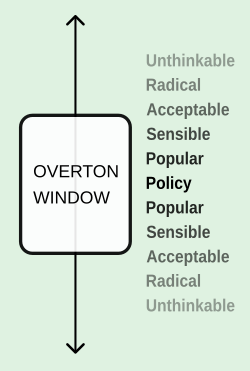
My model of Overton window shift amnesia is basically that most people don’t think about what’s okay from first principles alone. We take the temperature of the culture around us and measure ourselves relative to that. What we store in our heads is something like “I’ve always been a more progressive person” or “I’m kinder than average” (and everybody thinks they are better-than-average at most things). “What’s okay” on things like civil rights changes on the order of years and decades, so when we retrieve memories about the past regarding what was okay, we think “I’ve always been a more progressive person” or “I was kinder than average” and apply it to today’s standards. Basically people have a bias for believing they are ahead of the curve as a personal trait, so it checks out that they would have always been on the historically winning side of big shifts.
This may sound bad, and there are a lot of bad things about it. But one really good thing about it is that it allows society to move forward. I really felt that LGBTQ rights had won when I saw a tweet (which for the life of me I could not track down) from a teenager who didn’t realize gay marriage had been illegal in his lifetime and why everyone had been making a big deal about LGBTQ rights. That’s the world we want, where progress is settled and even the very idea of discriminating on the basis of an arbitrary characteristic belongs in the past.
The bad part of Overton window shift amnesia is being doomed to repeat history. We so easily forget how much resistance we have overcome before for a just cause because those victories seem like foregone conclusions when you have retrograde amnesia. We forget why we can’t take shortcuts or listen to that charismatic man who has everything figured out for us.
The idea of pausing AI is zooming through the Overton window and I still see the amnesia after just three years!
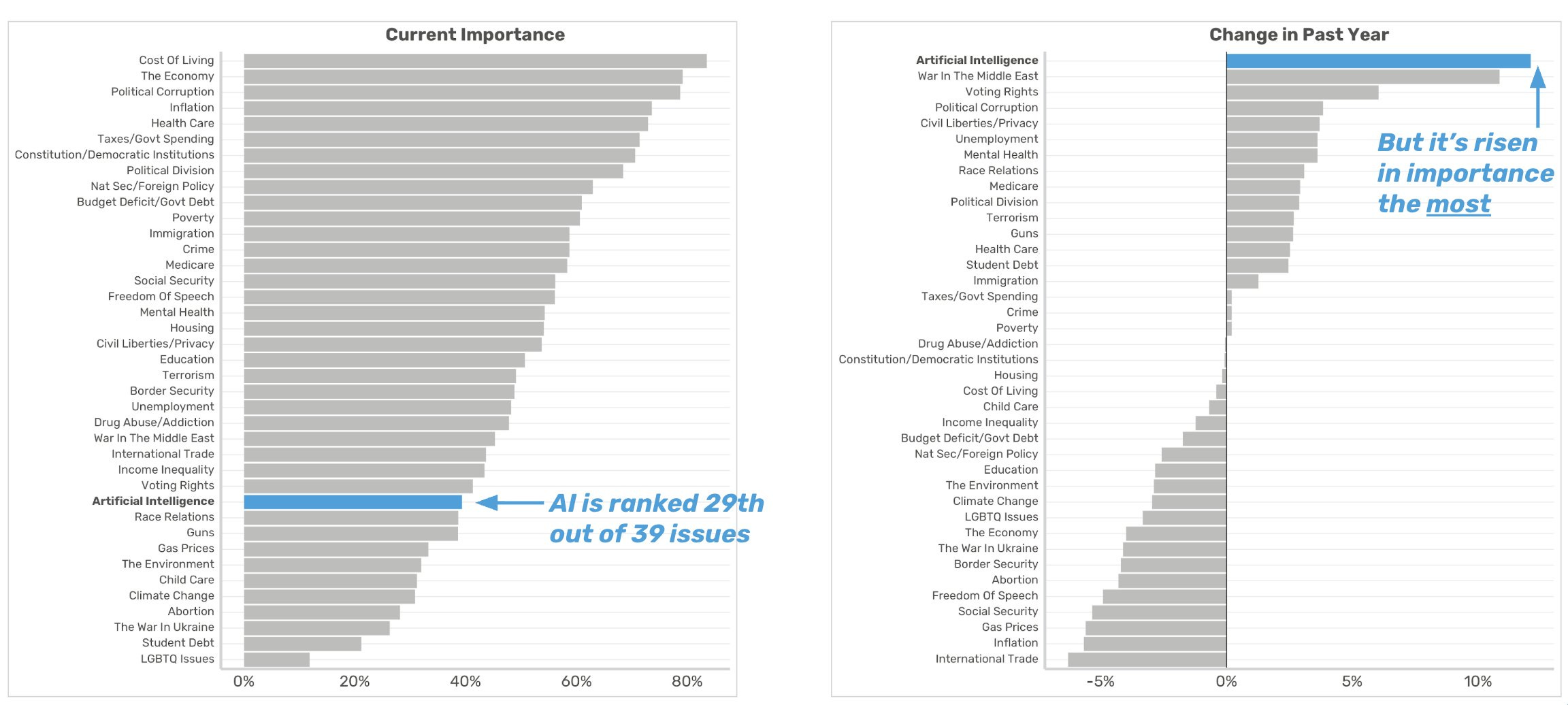
Political salience of AI issues. When I started organizing PauseAI US, the AI Safety experts around me in Berkeley told me a pause was all but impossible, technically and politically. I was asking them what they thought of Pause precisely because the idea had polled so well after the Future of Life open letter for a 6-month pause. Didn’t that show the public sees the danger? Sure, they said, but the issue isn’t salient to them. Well, now, barely three years later, Americans rank AI danger as more important than abortion or guns.
Mainstream acceptance of x-risk. The Berkeley experts said existential risk is just too “weird” for mass movement-building. Outside the Overton window. And politicians weren’t really any better, in their estimation. They would bounce off the weirdness of the topic and see doing anything about it as sticking their neck out. Well, just three years later, literally this week former Senator and Presidential candidate Mitt Romney said extinction risk from AI was “our highest and most urgent national priority”. He also authored some pretty decent legislation (despite its goofy name “Preserving American Dominance in Artificial Intelligence Act of 2024”) on AI Safety before leaving office. You don’t get more mainstream than endorsement.


Government capacity and right to regulate AI. The Berkeley experts and much of the tech world talked about Moore’s law style trends in developments as if they were laws of nature, saying that superintelligence was inevitable and tech progress cannot be stopped. Just yesterday the White House used export controls to effectively shut down all access to Anthropic’s Claude Fable. Because Anthropic is the leading AI company and Fable/Mythos their most frontier model, this is a partial pause in one swoop.
The moral argument against AI development. Quite a few characters on twitter and, again, the Berkeley experts would have told you it was not only futile (because tech progress is “inevitable”) to regulate AI, but deeply wrong. Just last year, former White House AI and Crypto czar said, in an utterly typical remark on AI regulation, “We’ve got to let the private sector cook”. He was one of the architects of the state AI regulation preemption scheme to shield the AI industry from as much regulation as possible. Yesterday he shared this New York Times op-ed, screenshotting a section saying that developing AI should be immediately stopped if any of the dire warnings CEOs like Dario Amodei give are true, that any other response would be “monstrous”, and captioned it “Yes”.
Zooooooooom goes the Overton window!
Like many fights before, pausing AI will very likely feel impossible until it feels inevitable. There is a long way to go to an international treaty to pause AI until it’s safe and consensual. It looks a lot longer if you forget how far we’ve come, and how fast. The most effective way to fight Overton window shift amnesia is to remember that we have a bias to believe it has always and will always be like it is now. But what’s unthinkable today can shift into obviously true before you even know it. It has happened before and we must make it happen again to save the world from AI danger. #PauseAI